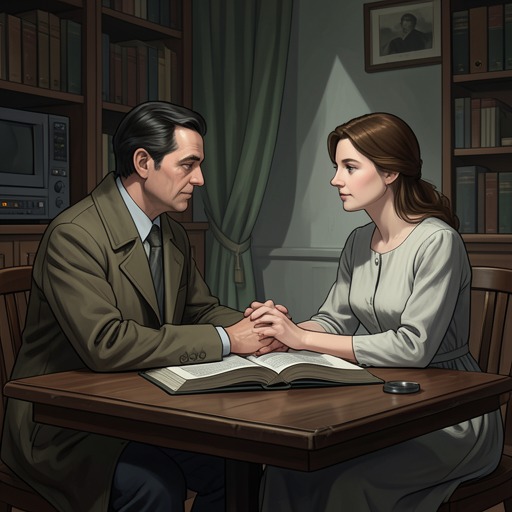
Knecht and Father Jacobus’s Exchange of Instruction
The Glass Bead GameKnecht and Father Jacobus’s Exchange of Instruction is a gradual intellectual friendship at Mariafels in which a Castalian Glass Bead Game Master and a Benedictine historian teach across the limits of their respective traditions. Jacobus gives Knecht a sustained education in historical thought, especially in the irreducible particularity of events; Knecht, through patient conversation rather than formal advocacy, helps Jacobus move from dismissing Castalia to accepting its intellectual purpose. Their exchange becomes one of the most consequential fruits of Knecht’s years at the monastery and a decisive stage in his awakening to history.
The Invitation and the First Lessons
Jacobus first came into focus for Knecht through another young man’s reverence. After seeing Anton linger at the door of the scholar’s study, Knecht began paying attention to the Benedictine historian, already known as an authority on the history of his Order. Jacobus eventually invited Knecht to visit after vespers. He made clear that he was neither a specialist on Castalian history nor a Glass Bead Game player, but that the increasingly close friendship between their two Orders was a reason to become personally acquainted.
Their first evening together began with music. Knecht heard Jacobus playing a sonata by Purcell before he knocked at the scholar’s door; inside, two candles still burned beside the small piano. Jacobus explained that he played for half an hour or an hour each night, stopping work at dusk rather than reading or writing before sleep. The conversation ranged from Purcell and Handel to the Benedictines’ musical tradition, and then to the history of the Order. When Knecht asked about Castalia, Jacobus acknowledged that he had scarcely studied it and stated his fundamental criticism: he regarded the Castalian Order as an imitation of Christian institutions, but one without religion, God, or Church as its foundation. Knecht answered respectfully that other religious and intellectual traditions existed and that Castalia’s intentions and influence on the life of the mind should not simply be denied.
Historical Study and Disputation
The conversations became a form of instruction that worked in both directions. Jacobus possessed formidable historical knowledge, while Knecht came to him as a trained but still intellectually supple young listener. Their talks often turned into regular disputations, complete with attacks and rebuttals. Jacobus initially pressed the arguments more aggressively. He attributed what he disliked in Knecht’s thought to Castalia’s modern abstractions, while treating Knecht’s sounder or more humane judgments as evidence that the young man’s nature had resisted the harm of his education. Knecht generally remained calm, replying when he thought Jacobus had carried his criticism too far.
The disagreement that most decisively changed Knecht’s mind concerned Castalia’s relation to world history. Jacobus argued that Castalian learning had fashioned history to suit its own tastes, concentrating on ideas and art while neglecting the lived reality of events. A history preoccupied with patterns and formulas, he insisted, could lose sight of individuals, moral consequences, and the passage of time. Knecht asked how history could be studied without being ordered; Jacobus accepted that ordering was necessary to every science, but warned that a method becomes distorting when it replaces the unique reality under examination. His comparison was to an anatomist who sees only the pattern expected before beginning the dissection. Historical study must use methods without mistaking them for the event itself.
For Jacobus, history was at once an intellectual discipline and a serious moral undertaking. To study it was to attempt what was fundamentally impossible yet necessary: to submit to chaos while retaining faith in order and meaning. That formulation gave Knecht a different standard by which to judge Castalian learning. History was not an irresponsible game in which reality could be rendered harmless by abstraction; it demanded respect for what could not be completely organized or explained. Through Jacobus, Knecht learned the laws and contradictions of historical study and, beyond them, to see both the present and his own life as historical realities.
Reciprocal Change and Growing Trust
The friendship did not begin with agreement. Jacobus regretted that Knecht had grown up without religious education and believed that Castalia substituted an intellectual and aesthetic system for religious discipline. Yet he also discovered that the young man could respond to criticism without becoming rigid or defensive. Knecht, for his part, did not simply reject Jacobus’s attacks: he recognized that some of the historian’s criticisms of Castalia contained a partial truth, and he changed his view on the question of historical consciousness.
That mutual adjustment developed slowly. The narrator compares the Castalian influence on Jacobus to seeds from high mountains planted in lush lowland soil: the old scholar’s caution and inherited habits made trust take root only inch by inch. Knecht’s most prized gain from Mariafels was this tentative growth of openness. Jacobus moved from using “Castalian” and Glass Bead Game player as ironic or dismissive labels toward tolerating and eventually respecting the different mentality they represented. He ceased to treat the Glass Bead Game as mere aesthetic dandyism, stopped carping at the Order’s relative youth, and no longer ruled out friendship or alliance between the two institutions.
Knecht considered this partial change in Jacobus a personal reason for joy, though he did not realize that Castalian authorities regarded the association as the most important accomplishment of his Mariafels mission. The exchange therefore exceeded private education: it made a limited but meaningful rapprochement between two Orders with markedly different histories and foundations. Neither man simply converted the other to his own position. Their progress consisted instead in learning to recognize the value—and the limits—of a different intellectual and spiritual inheritance.
Lasting Significance
For Knecht, Jacobus’s instruction enlarged the meaning of awakening. It connected the study of the past to awareness of the present, and placed Knecht’s own life within history rather than outside it in an abstract, timeless intellectual order. The lesson challenged a central Castalian habit: turning the past into a system of ideas and forms while overlooking the distinctive reality of the people and events that made it. Knecht’s respect for order survived, but it became answerable to the disorder and particularity that order can never fully absorb.
The exchange also gave practical substance to the growing friendship between Castalia and the Benedictines. Jacobus’s changed judgment did not erase the difference between a religious Order and a Castalian institution without a Church or God as its basis. Instead, sustained study and disputation made it possible for him to accept Castalia as a serious, distinct attempt to cultivate an aristocracy of the spirit. In that movement—from suspicion to qualified respect—their conversations joined personal education to institutional understanding, while the historian’s insistence on historical reality became one of the enduring intellectual gifts Knecht carried away from Mariafels.